
Exploration

Project History

The Batong Buhay Project was first discovered in 1934 by American soldiers and initially developed as an underground gold mine with a 300 tonnes-per-day mill, prior to ceasing operations during World War II.

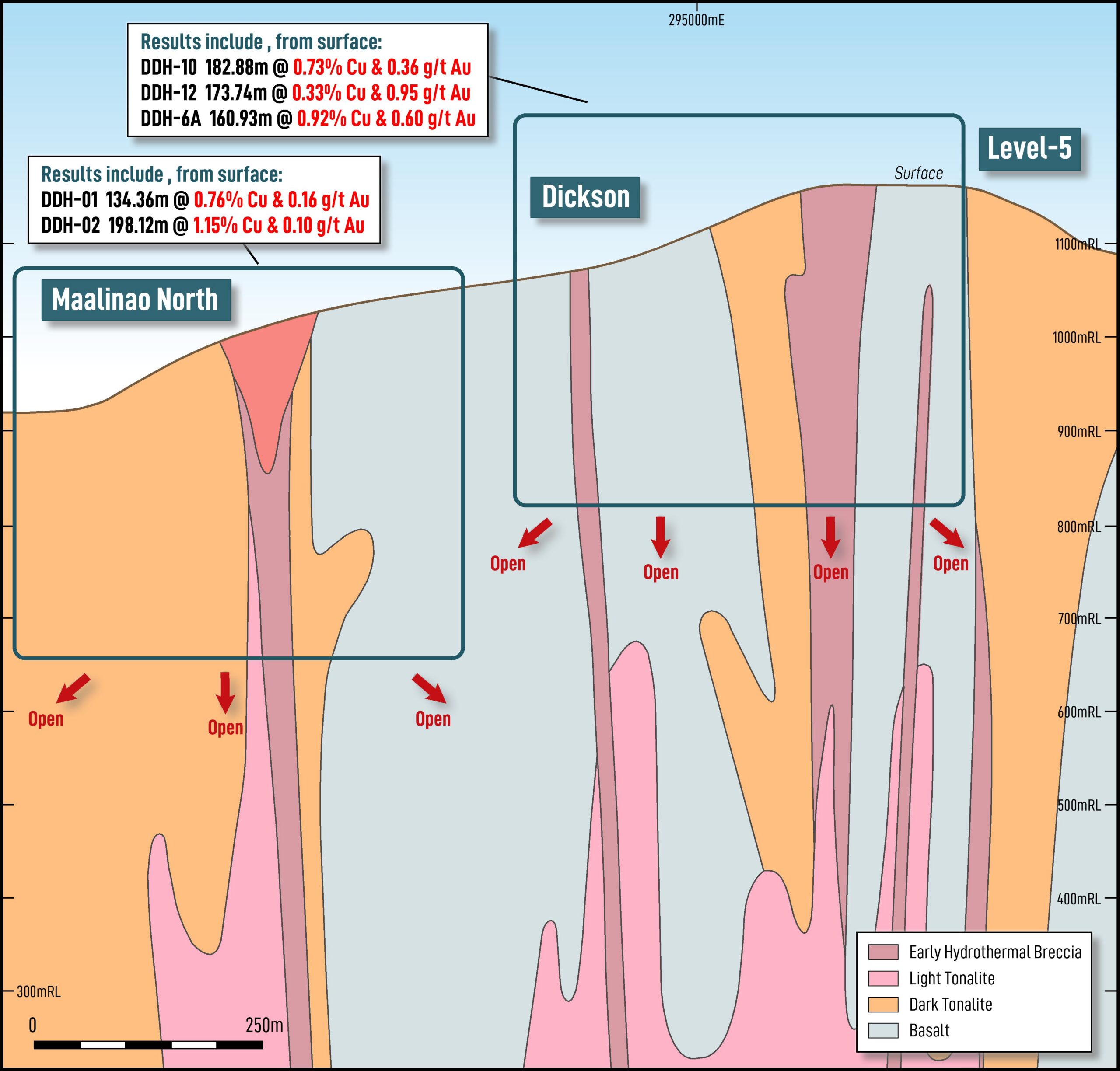
Interest in the Project was renewed in 1969, when its copper-gold porphyry potential was recognised. Previous explorers completed 21 diamond drillholes from surface during this period, with historical drilling showing continuous mineralisation from surface and every hole ending in mineralisation. Mining was subsequently undertaken at the Dickson deposit from 1979 to 1984 via an underground block cave which delivered 1,097,290 tonnes to the plant with an average mill head grade of 1.1% Cu and 1.9 g/t Au.

In June 2026, Metals Exploration entered into a series of agreements with the Balatoc (Kalinga) Tribe, Inc. and the Philippine Mining Development Corporation, securing exclusive rights to explore, develop and operate the Project (see the Overview tab for deal structure detail).

Current Exploration Programme

Batong Buhay has not been subject to modern exploration techniques. Having secured exploration rights, Metals Exploration has commenced a pre-drilling work programme comprising:

  • A LIDAR survey of the Project area.
  • A drone-based magnetic and radiometric survey.
  • Detailed geological mapping.
  • A rock chip sampling survey of historical tunnels and outcrops.
  • Regional geochemical soil sampling.
  • Finalisation by PMDC of the Exploration Permit (EXPA-079) with the Mines and Geosciences Bureau, to enable drilling activities to commence.

The results of this work programme will be incorporated into a geological model to design a drill programme, anticipated to commence in H2 2026. The programme will target both the porphyry copper-gold mineralisation at Dickson and Maalinao North and the high sulphidation epithermal gold vein system at Level 5, as well as testing the previously undrilled zone between the two porphyry centres.

Historical Drilling Results

21 historical diamond drillholes have been completed at Batong Buhay by previous explorers:

Hole Width (m) Cu % Au g/t
DDH-01 134.36 0.76 0.16
DDH-02 198.12 1.15 0.10
DDH-03 78.00 0.28 0.12
DDH-05 198.12 0.39 0.17
DDH-06 56.39 0.36 0.27
DDH-07 198.42 0.41 0.10
DDH-08 309.00 0.66 0.19
DDH-10 182.88 0.73 0.36
DDH-11 348.00 0.12 0.56
DDH-12 173.74 0.33 0.95
DDH-13 360.00 0.09 0.15
DDH-14 66.14 0.09 0.10
DDH-15 152.40 0.39 0.11
DDH-16 93.27 0.13 0.11
DDH-17 216.00 0.28 0.19
DDH-18 150.57 0.30 0.18
DDH-19 299.31 0.57 0.30
DDH-20 211.53 0.58 0.40
DDH-24 198.12 0.26 0.12
DDH-6A 160.93 0.92 0.60
DDH-S1 61.72 0.57 0.48

*CuEq figures have been calculated using metal prices of US$3,500/oz Au and US$5.50/lb Cu (US$12,120/t), with 100% metallurgical recovery assumed for both metals. CuEq is used for comparative purposes only and is not necessarily indicative of future recoveries or economic outcomes.

The historical Mineral Resource estimate referred to on this page is non-JORC compliant. A Competent Person has not done sufficient work to classify the historical estimate as a current Mineral Resource in accordance with the JORC Code, and it should not be relied upon.

Competent Person's Statement: Mr Maxwell Donald Tuesley, BSc (Hons) Economic Geology, a member of the Australian Institute of Mining and Metallurgy (No 111470) and an employee of the Company, has compiled, read and approved the technical disclosure contained on this page in accordance with the AIM Rules – Note for Mining and Oil & Gas Companies.